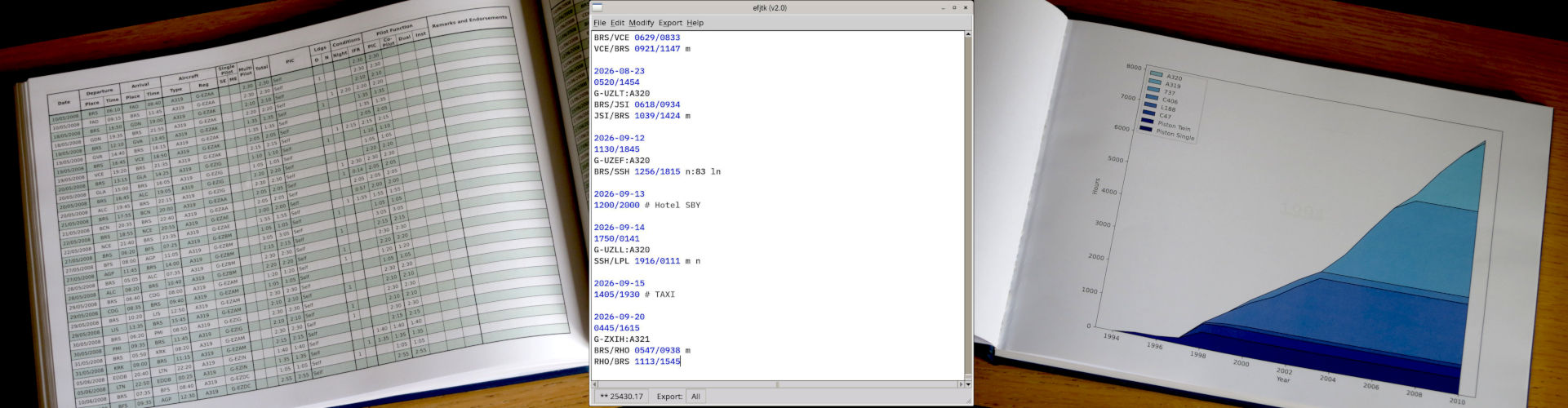
The eFJ schema is extremely intuitive, so you can learn nearly all you need to know in less than 10 minutes. The tutorial takes you through the process of entering data using a couple of days of my flying. It uses the web interface, so there is nothing to install, you can just jump right in.
While the web interface does work on mobile devices, it is preferable to do the tutorial on a device with a proper keyboard — entering punctuation on an on-screen keyboard can be a fairly frustrating experience!
Installing locally gives you a full featured graphical interface and, for advanced users, a command line interface. The graphical interface includes features such as syntax highlighting that are unavailable in the web interface.
Local installation also gives you self-reliance. Even if I was to take the website down you will be able to continue to use the toolkit indefinitely.
The toolkit is distributed as a single Python file. This does not, itself, require installation, but, unless you are a Linux user, it is likely that you will need to install a Python interpreter to run it. The instructions below give full details.
Many users will have flight records that they need to convert to the eFJ schema.
If you are an easyJet pilot, you can download up to two years of
flying records as an “AIMS pilot logbook report” from eCrew, feed it
into my web-based converter and get out an eFJ
that requires only a fairly modest amount of modification — you just
need to add m flags to the sectors for which you were
PM then run the toolkit's “Night” tool and, if applicable, the “FO”
tool. This may also work for you if your airline uses the same
generation of eCrew as easyJet.
Otherwise, some form of data conversion is going to be required. The problem with this is that while the eFJ schema is well documented, the data to be converted can be anything at all, from a hand crafted spreadsheet to an obscure backup file from one of the hundreds of online logbook offerings. There can also be significant corruption in the data, particularly if it has been through more than one logbook solution. If you would like help dealing with all this, I can take a look at whatever data you have and potentially help you convert it; the fee for this will depend on what I'm dealing with, but will usually be around £50. If you would like me to take a look, please email a copy of your data to hursts.org+logbook@gmail.com and I'll send you a quote.
The HTML files created by the toolkit are intended to be compatible with a wide variety of tools, including any modern web browser or spreadsheet. The capabilities of these tools can then be leveraged to achieve many things. In particular, browsers can give you nice PDF output (you may need to section up a large logbook to avoid overwhelming them) and spreadsheets can give you any charts you fancy.
The logbook output is in the form required by EASA, which has also been adopted by the UK CAA. If you need a differently formatted logbook for your controlling authority, please email me the details at hursts.org+logbook@gmail.com — the software is set up such that this will likely be a fairly easy thing to achieve.
It is possible to create hard back books from an eFJ using a service such as Lulu. I have mine in two volumes, each covering 15 years of flying. It is sectioned into years, with a title page at the beginning of each section and a rolling summary at the end. These are very pleasing aftefacts, and fairly cheap (mine were £20 each), but getting everything set up can be a little tricky. If you would like help in doing so, again for a modest fee, please email me.